
Morse Code Translator
Instantly convert text to Morse code and Morse code back to text with fast and accurate results.
What Is Morse Code?
Morse code is a communication system invented in the 1830s by Samuel Morse and Alfred Vail that represents every letter, number, and symbol as a unique sequence of short signals called dots(.) and long signals called dashes(-). Before telephones, Wi-Fi & internet the people use this way to send messages instantly across oceans and continents.
The english to morse code translator on this page uses the globally accepted International Morse Code standard set by the ITU, ensuring every translation you make is universally accurate. Just two symbols — and yet together they once connected the entire world.
Hands-On Morse Code Translator in Seconds
We believe the best morse code translator should be powerful yet simple. We designed our online tool to provide a hands-on, real-time translation experience that feels both magical and intuitive. The process to translate morse code or convert text is seamless.
1. Type Your Message
Getting started is incredibly easy. Simply begin typing in the provided input box. Our intelligent translator is designed to understand your intent. If you type a standard message like “Hello world,” our text to morse code engine will instantly begin the conversion process. Conversely, if you enter a sequence of dots and dashes, our morse to text decoder will immediately recognize it as Morse code and start translating it back to plain English. There is no need to switch modes or select options; the system works for you.
2. Instant Translation
This is where the power of real-time processing shines. As you type, the translated output appears instantly in the results area. There is no frustrating delay or need to click a “submit” button. This instant feedback loop makes our online morse code translator one of the most efficient and user-friendly platforms available. Whether you are encoding a long paragraph or quickly trying to decode Morse from a puzzle, the speed of our tool ensures you get your answer the moment you need it. This commitment to instant results is what makes our free morse code utility stand out.
3. Listen and Learn
True mastery of Morse code comes from hearing it. That is why our code translator includes a high-fidelity audio playback feature. After you convert text, you can click the play button to hear your message as a series of clear, rhythmic beeps. This morse code translator audio function is more than just a novelty; it is a critical learning tool. By listening to the audio Morse code, you train your ear to recognize the unique sound of each letter and number, moving you beyond simple visual recognition and toward genuine fluency.
Features of Our Morse Code Translator
This free online tool has been packed with a suite of professional features designed to provide a comprehensive and complete experience. We aimed to create more than just a simple morse code converter; we built a full-featured translator hub.
1. Convert Text to Morse Code
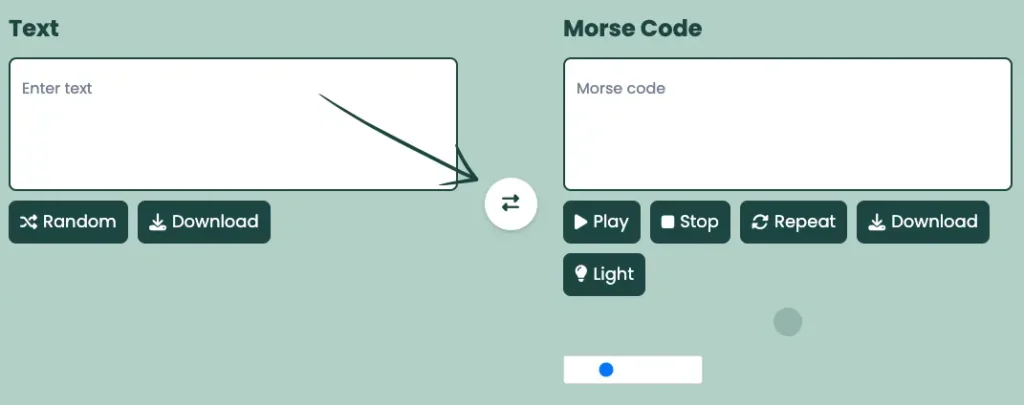
The primary function of our morse code generator is its ability to flawlessly convert text into International Morse code. You can type or paste any amount of text, from a single word to an entire essay, and our tool will generate a clean, accurate, and perfectly formatted Morse translation. This is ideal for students, puzzle creators, or anyone needing to create a message in Morse code from scratch.
2. A Powerful Morse to Text Converter
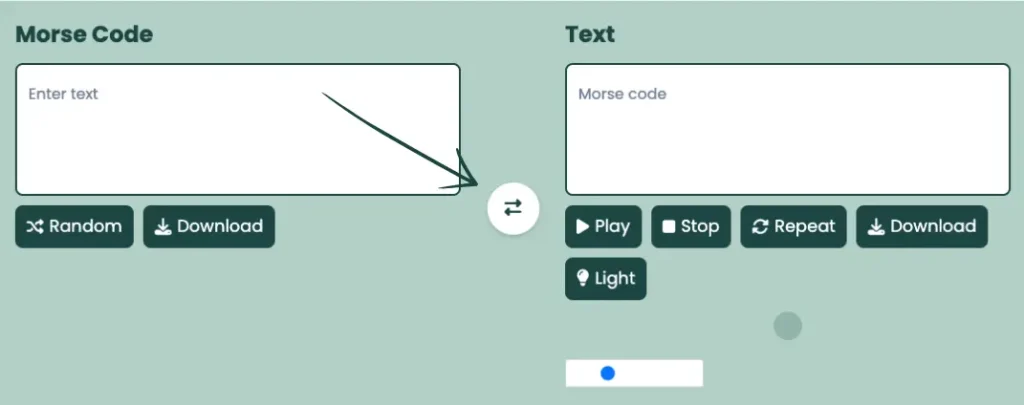
Our platform also excels as a robust morse code decoder. If you have a string of Morse code that you need to understand, our translator can decipher it with exceptional accuracy. Simply paste the code into the input box, ensuring you use a forward slash (/) to denote spaces between words. Our morse to text engine will instantly decode Morse and present you with the clear, readable English translation. It is the perfect tool for solving ciphers or understanding messages you have received.
3. Play Morse Code Audio
The integrated morse code translator audio is a cornerstone of our platform. We understand that Morse is an auditory language. The audio playback feature allows you to hear any generated Morse code with exceptional clarity. This is indispensable for learners who need to associate the sounds of dots and dash with their corresponding characters. The audio Morse code output helps to solidify the connection between the visual symbols and their rhythmic sound.
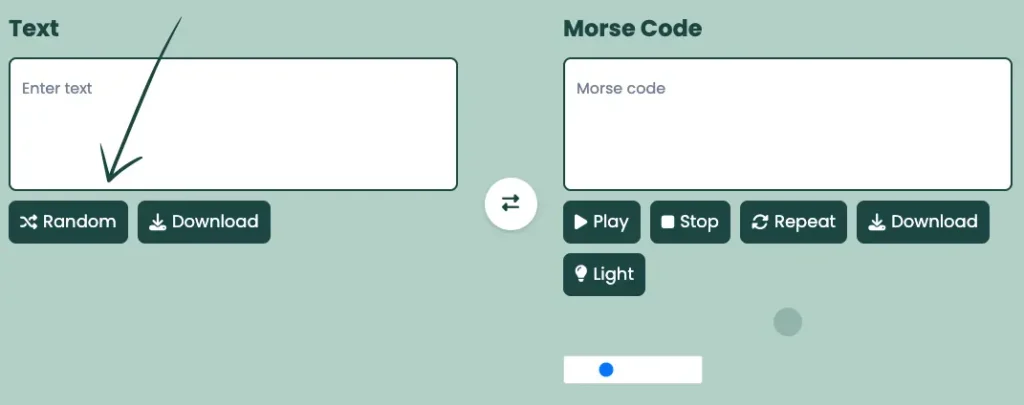
4. Generate Random Messages
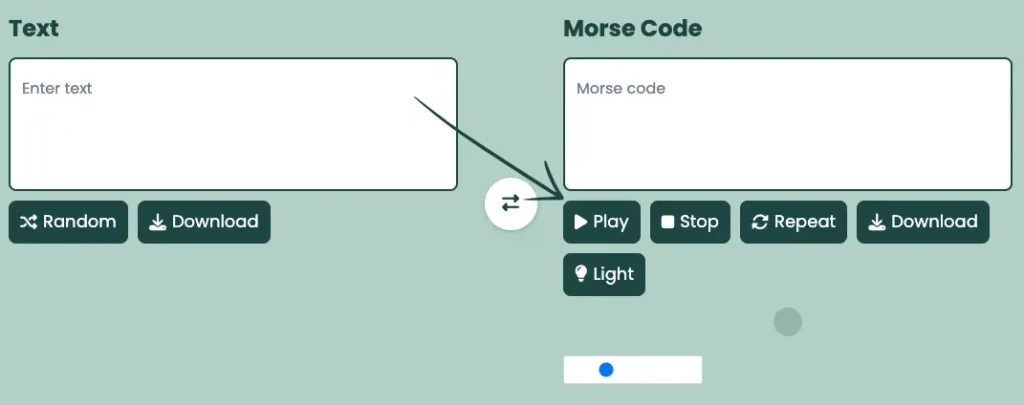
To truly learn, you need to practice. Our tool includes a unique feature that acts as a practice morse code generator. It can create random words and phrases in Morse code for you to work on. This is an excellent way to test your decoding skills without knowing the answer beforehand. It turns our online tool into an interactive training ground, helping you sharpen your ability to decode morse on the fly.
5. Visual Light Playback
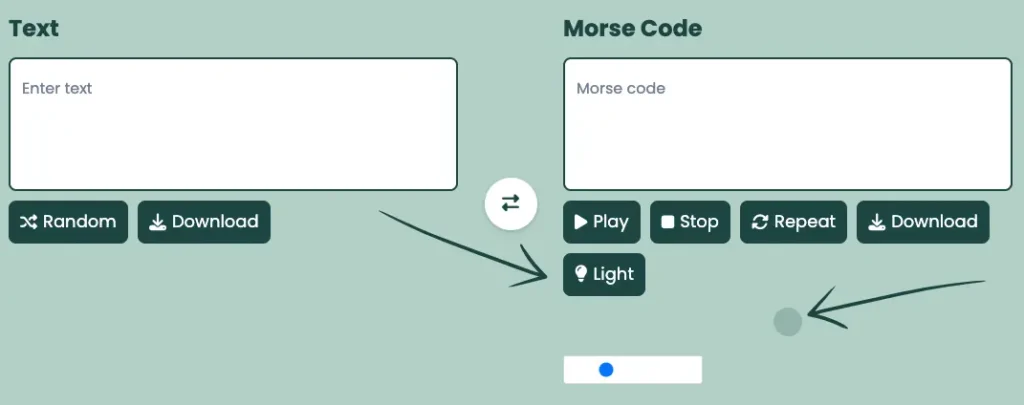
To offer a complete sensory experience, our translator includes a visual light playback feature. This simulates how Morse code would be transmitted using a signal lamp on a ship or a flashlight in an emergency. After generating a message, you can watch it flash on your screen as a series of short and long bursts of light. This visual feedback provides another powerful way to learn and understand the structure and timing of the code.
Learn the Morse Code Alphabet, Numbers and Symbols
To truly master Morse, you must learn its alphabet. The following section provides the complete chart for International Morse Code, which is the global standard used by our morse code translator. Paying close attention to the structure of letters, numbers, and symbols is the first step toward becoming proficient.
The Complete Morse Code Chart (A–Z, 0–9, and Symbols)
Below you will find the comprehensive charts used by our code translator. We strongly recommend focusing on learning the sound and rhythm of each character through our audio playback feature, rather than just visually memorizing the dots and dashes. This auditory approach is far more effective for long-term retention.
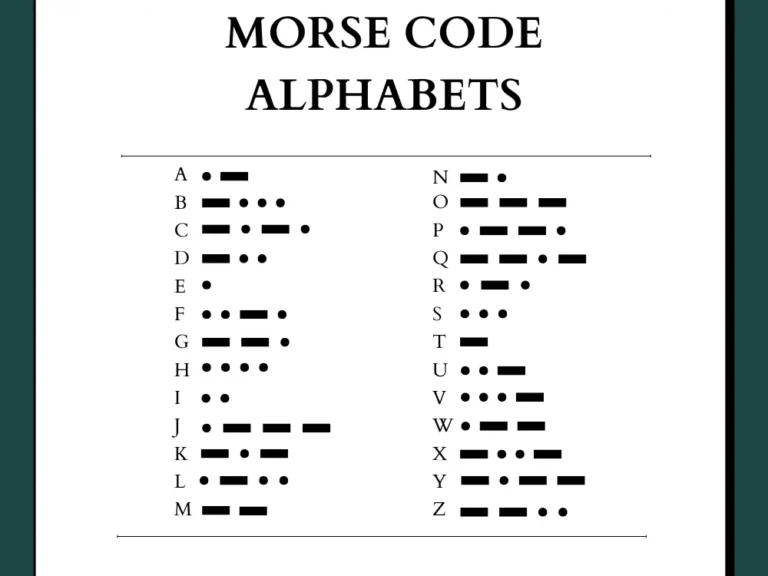
Morse Code Alphabets Chart
The foundation of the language is its 26 letters. Notice the patterns, such as opposites like ‘A’ (·−) and ‘N’ (−·), which can aid in memorisation.
(The table from the previous response showing A-Z would be inserted here as a clean HTML table).
Morse Code Numbers (0–9)
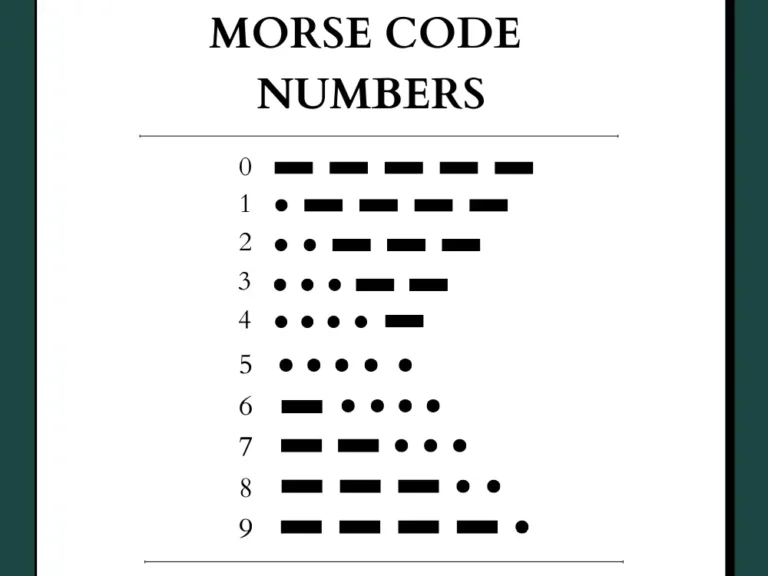
The system for numbers in Morse code is very structured and logical. Each number is represented by a sequence of five characters. Our morse code translator numbers function handles these perfectly, but learning them is crucial for decoding any message containing numeric data.
(The table from the previous response showing 0-9 would be inserted here).
Morse Code Punctuation and Symbols
| Punctuation & Symbols | Morse Code |
| Period (.) | • — • — • — |
| Comma (,) | — — • • — — |
| Question mark (?) | • • — — • • |
| Parentheses (() | — • — — • — |
| Colon (:) | — — — • • • |
| Slash (/) | — • • — • |
| Semicolon (;) | — • — • — • |
Learn the Patterns — Not Just the Dots
A common mistake for beginners is trying to brute-force memorize the chart. A much more effective strategy is to look for patterns. For example, some letters are composed only of dots: E (·), I (··), S (···), and H (····). Others are composed only of dashes: T (−), M (−−), and O (−−−). Recognising these letter families makes the learning process much faster and more intuitive than simple rote memorisation.
Don’t Forget Punctuation!
Punctuation is not an afterthought in Morse code; it is a critical component of clear communication. The difference between a statement and a question can be lost without the proper symbol. For example, the question mark (··−−··) completely changes the intent of a sentence. As you practice with our online tool, make an effort to include punctuation to make your encoded messages as clear and expressive as possible.
How to Read and Write Morse Code
Becoming fluent in Morse means developing two interconnected skills: the ability to read (decode) and the ability to write (encode). Our free morse code tool is the perfect companion for practicing both.
1.The Decoding Process: Reading Morse Code
Reading, or decoding, Morse code is the skill of translating incoming signals—whether sounds from our audio playback or flashes from the light visualizer—back into text. The ultimate goal is not to consciously count the dots and dash but to instantly recognize the overall sound or rhythm of a character. Start by using our online morse code translator to generate single letters and listen to them repeatedly. Soon, the rhythm of −·−· will simply mean “C” to your brain, without any intermediate thought.
2.The Encoding Process: Writing Morse Code
Writing, or encoding, is the reverse process. It involves taking a plain text message and converting it into the correct sequence of dots and dashes. As you use our text to morse code function, pay attention to the output. Try to internalize the rhythm of each letter as you see it generated. Think of the flow and timing required to transmit that character. This mental practice will build the foundation you need to eventually write Morse code from memory.
Master the Rhythm! The Heartbeat of Morse Code
The true secret to fluency in Morse code is mastering its timing. The rhythm is everything. The system is built on a precise timing relationship: a dash is three times as long as a dot. The silent space between the parts of a single letter is equal to one dot. The space between letters in a word is equal to three dots (or one dash). Finally, the space between words is equal to seven dots. Mastering this internal clock is what separates a novice from an expert operator.
Morse Code Sounds: The Rhythm of Communication
At its core, Morse code is an auditory language. While we can represent it visually with dots and dashes, its soul lives in its sound.
1.The Melody of Dots and Dashes
Every letter, number, and symbol in Morse has its own unique musical “melody” or rhythm. The world-famous distress signal, SOS (··· −−− ···), is instantly recognizable by its “di-di-dit, DAH-DAH-DAH, di-di-dit” cadence. It’s this rhythmic quality that makes the code so effective, even when the signal is weak or surrounded by noise. Learning to recognize these melodies is the key to auditory recognition.
2.Hearing the Code Come Alive
This is why the audio playback feature of our morse code translator is so vital. When you listen to the audio morse code, you are bringing the static symbols on the page to life. We encourage you to close your eyes and just listen. Let your brain begin to process the patterns as a language, not as a puzzle. This active listening trains your mind for real-world application, where you will be hearing the code, not seeing it.
3.Timing: The Silent Partner of Sound
Just as important as the sounds themselves are the moments of silence between them. The length of these pauses is not random; it is a critical part of the code’s grammar. These silences define the boundaries between letters and words, providing the structure that makes a long string of signals intelligible. Without proper timing, a message descends into a meaningless stream of beeps.
Learn Morse Code Step by Step
Ready to begin your journey to fluency? Our online tool is the perfect practice partner. Follow this proven, step-by-step method to learn effectively.
1. Start with Simple Letters E and T
Do not try to learn the entire alphabet at once. Begin with the two most basic letters: “E” (·), a single dot, and “T” (−), a single dash. Use our translator to type “E” and “T” and listen to the audio playback over and over again until their sounds are unmistakable.
2. Add Short Words to Build Flow
Once you are comfortable with a few letters, start combining them to form simple words. If you’ve learned E, T, I, S, A, and M, you can practice words like “IT,” “IS,” “AT,” “TEA,” “EAT,” and “SAT.” This helps you master the crucial skill of proper spacing between letters.
3. Reinforce Memory with Tools
Use our free online tool as your digital flashcard system. Type in words and then listen to the audio morse code output. Cover the screen and try to decode the message by ear. This active recall method provides instant feedback and dramatically accelerates the learning process.
4. Listen and Repeat Every Day
Consistency is the single most important factor in learning Morse code. Dedicate just 10 to 15 minutes every single day to practice. This regular exposure is far more effective than one long session per week. Daily practice builds and reinforces the neural pathways required for instant character recognition.
5. Decode Real Messages
Once you have a handle on the alphabet, it is time to test your skills. Use our tool’s random message generator to challenge yourself with new material. You can also find recordings of amateur radio (HAM) conversations online. Trying to decode morse from these real-world sources is the ultimate test of your progress.
Modern Uses of Morse Code
Many people assume Morse code is an obsolete relic of the past, but it is still actively and importantly used in a variety of modern fields.
Amateur Radio and HAM Communication
For hundreds of thousands of amateur radio operators around the world, Morse code (often called “CW” for “Continuous Wave”) is a primary and highly respected mode of communication. It can be used to make contact across continents with very low power, often succeeding where voice communication fails.
Aviation and Navigation Signals
Pilots still rely on Morse code for navigation. Certain ground-based navigational aids, called NDBs and VORs, continuously transmit their three-letter identifiers in Morse code. Pilots listen to this audio signal to confirm they are tuned to the correct beacon for their flight path.
Military and Rescue Signals
Naval signalmen and special forces units in militaries around the world still learn Morse code. It provides a simple, low-tech, and difficult-to-intercept method of communication using flashing lights or radio clicks. Furthermore, the distress signal SOS remains the universal, unambiguous call for help.
Gaming, Puzzles, and Escape Rooms
Morse code is a favourite element for game designers and puzzle makers. It is frequently used to hide “Easter eggs” in video games, to pass clues in alternate reality games (ARGs), and as a challenging puzzle element in physical escape rooms. Our morse code decoder is a popular tool for players of these games.
Accessibility and Assistive Communication
Morse code has found a noble modern use as a powerful assistive technology. For individuals with severe physical disabilities who may only have control over a single muscle, a switch can be used to input Morse code. This allows them to type, control a computer, and communicate with the world.
Education and Coding Applications
In education, Morse code serves as a perfect, tangible introduction to the concept of binary encoding. It beautifully illustrates how complex information (the alphabet) can be represented with just two simple states (on/off, dot/dash), the foundational principle behind all modern computers and digital technology.
A Timeless Connection
In our hyper-complex technological world, Morse code offers a refreshingly simple and direct method of connection. It is a universal language that, with the most basic equipment, can bridge any distance, providing a timeless beat of human communication.
Why Morse Code Still Matters Today
The persistence of Morse code in the digital age is a testament to its robust design and enduring value. It is far more than a historical curiosity.
1. Morse Code as a Skill and Hobby
Learning Morse code is a fantastic mental exercise. It enhances concentration, improves memory, and offers the deep satisfaction of acquiring a unique and challenging skill. As a hobby, it connects a global community of enthusiasts who share a passion for its history and application.
2.A Lifeline in Emergencies
Morse code is the ultimate backup plan. In a catastrophic scenario where the internet, satellites, and cell towers fail, the ability to send a message with a simple flashlight, a mirror, or a radio switch can be a literal lifeline. Its simplicity is its greatest strength.
3.A Cultural and Nostalgic Treasure
The rhythmic beat of Morse code is the sound of the modern world being born. It represents the very dawn of instant global communication and holds a powerful nostalgic and cultural significance. Every time you use a morse code english translator, you are participating in this rich history.
4.Morse in Technology and Encryption Basics
The binary nature of Morse makes it an excellent teaching tool for the core principles of digital logic and encryption. Understanding how a full alphabet can be encoded into two states provides a foundational insight into how all modern digital information is stored and transmitted.
5.The Timeless Beat of Communication
The rhythmic pulse of Morse code is perhaps the most fundamental form of technological communication. Its ability to convey complex thought through simple, structured patterns is a testament to its brilliant design. It remains a powerful and reliable way to send a message when all else fails.
How to Use the Morse Code Translator
Our tool is designed for maximum simplicity and power. Here is a clear breakdown of its primary functions.
Translate text to Morse code
To use our text to morse code feature, simply begin typing your message in plain English into the input box. As you type, you will see the accurate Morse code equivalent generated in real time in the output section. You can then copy this code or listen to the audio playback to hear how it sounds.
Decode Morse code to text
To decode morse code to english, you can type or paste a string of Morse code directly into the same input box. Ensure your code is properly formatted, using dots (.), dashes (-), and a forward slash (/) to indicate the space between words. Our intelligent online algorithm will instantly convert it back into readable text for you.
Want to Learn More Morse?
You have discovered the best morse code translator and the most comprehensive learning hub available online. Your journey into the fascinating world of Morse starts here. We encourage you to bookmark Morse Zone and make our powerful free online tool your daily practice partner. Use the robust morse code converter, listen to the audio, and challenge yourself with the playback features. The timeless and rewarding skill of Morse code is at your fingertips.
Why Choose Our Morse Code Translator
In a sea of online utilities, we have focused on creating the single best morse code translator by prioritizing quality, features, and user experience. Our free online tool is fast, completely accurate, and built with a clean, modern interface that works perfectly on both desktop and mobile devices. But it’s our commitment to being more than just a code translator that sets us apart. With integrated, powerful learning features like customisable audio playback, visual light signals, and practice generators, our platform is a complete Morse code hub, designed to be your trusted partner on your journey to mastery.
Fun Facts About Morse Code
The influence of Morse code can be found in surprising corners of modern culture. The iconic default Nokia “SMS” ringtone is actually the Morse code for the letters “SMS” (··· −− ···). The very first official message sent by Samuel Morse in 1844 was the poetic phrase, “What hath God wrought.” In a more dramatic example, during the Vietnam War, American POW Jeremiah Denton, while being forced to participate in a propaganda interview, blinked the word “T-O-R-T-U-R-E” in Morse code, covertly informing U.S. intelligence of the true conditions of his captivity.
How to Improve Morse Code Skills
To accelerate your learning beyond basic practice, many experts recommend the Koch Method. This technique involves learning the letters at your full target speed (for example, 20 WPM) right from the start. You begin with just two letters and do not add a third until you can differentiate between the first two with at least 90% accuracy. This method is highly effective because it trains your brain to recognize the sound of a character at speed, rather than learning slowly and having to re-learn at a faster pace later. Our tool, with its adjustable WPM setting, is perfect for this method.
Advanced Practice Techniques
Once you have built a solid foundation with individual letters and short words, advanced practice techniques including word-pattern recognition, high-speed contest copying, and head-copy practice without writing down decoded letters accelerate your development toward genuine conversational morse fluency. Head-copy — decoding a full morse message without writing anything down — is the gold standard of morse proficiency because it requires complete automation of pattern recognition at a level that analytical counting can never support. Use the random message generator at your current comfortable speed for daily head-copy attempts, starting with two-word messages and extending length as your working memory for morse patterns expands over successive practice sessions. Engaging with online ham radio communities and participating in organized morse code contests provides real-world performance benchmarks and social accountability that solo practice cannot replicate.